

The 11th Annual HBCU Climate Change Conference concluded as a powerful convening of scholars, students, community leaders, and environmental justice advocates committed to advancing environmental justice and resilience in frontline communities. Co-hosted by the Bullard Center for Environmental and Climate Justice and the Deep South Center for Environmental Justice, the multi-day gathering in New Orleans reaffirmed the essential role of HBCUs in bridging research, policy, and community-driven solutions at a critical moment for environmental and climate action. Under the theme Legacy Rising: Charting Our Future at the Crossroads of Climate and Justice, the conference honored groundbreakers of the EJ movement and elevated youth and community leadership, while reinforcing a shared long-term commitment to protecting communities.
Day One:
Day One began with an open gathering that honored the roots of the environmental justice (EJ) movement and the leaders who helped to shape it. The evening centered celebration, grounding the conference in the history that continues to guide today’s environmental and climate work. Attendees heard directly from pioneering voices and witnessed the presentation of the EJ Groundbreakers Medallion, recognizing individuals whose lifelong commitment has advanced EJ at the community, national, and global levels. The program was interwoven with cultural expression, including a performance by Shaka Zulu and the Zulu Connection, and powerful spoken word from Sunni Patterson, reminding the audience that art, culture, and resistance have always moved alongside the movement. Honorees included: Dr. Robert D. Bullard, Dr. Beverly Wright, Jose Bravo, Charles Lee, Vernice Miller-Travis, Dr. Paul Mohai, Dr. Mildred McClain, Tom Goldtooth, Susana Almanza, Richard Moore, and Donele Wilkins. All of these leaders have worked to lay the foundation for EJ as it exists today. The Community Forum set the tone for the days ahead, affirming that the movement’s strength lies in honoring its legacy while creating space for new voices to emerge.

Day Two:
Day Two opened with an ancestral welcome led by Cierra Chenier, writer, historian, and representative of Noir ’N NOLA. Chenier guided attendees through the legacy of advocacy and resilience within Black communities, framing environmental justice (EJ) as both an inherited struggle and a living responsibility. Her remarks reminded participants that today’s work is built on generations of relentless resistance.
Dr. Beverly Wright, Founder and Executive Director of the Deep South Center for Environmental Justice, followed with a presentation that highlighted the disproportionate burden of environmental pollution on Black, Brown, and under-resourced parishes across Louisiana. Dr. Wright posed a sobering question to the audience: as conditions evolve, have the underlying injustices truly changed?
She illustrated this reality through the story of Morrisonville, Louisiana, which was once a thriving, predominantly Black community in Iberville Parish. It now stands abandoned due to severe pollution from nearby industrial pollution in the 1970s and 1980s. The case served as a stark reminder that harmful industrial expansion continues to erase communities.
Bridging lived experience with environmental data, Alan Sealls, President of the American Meteorological Society, connected qualitative community narratives to quantitative climate research. Sealls emphasized that climate change is not theoretical, it is measurable, observable, and already shaping our daily lives. While acknowledging the scale of the challenge, he reinforced that collective action at every level can reduce harm and protect future generations. This theme of community leadership carried into a grassroots discussion featuring, Darren Leach, Joe Womack, and Joy Banner, community leaders who shared insights from advocacy efforts across the Gulf Coast.
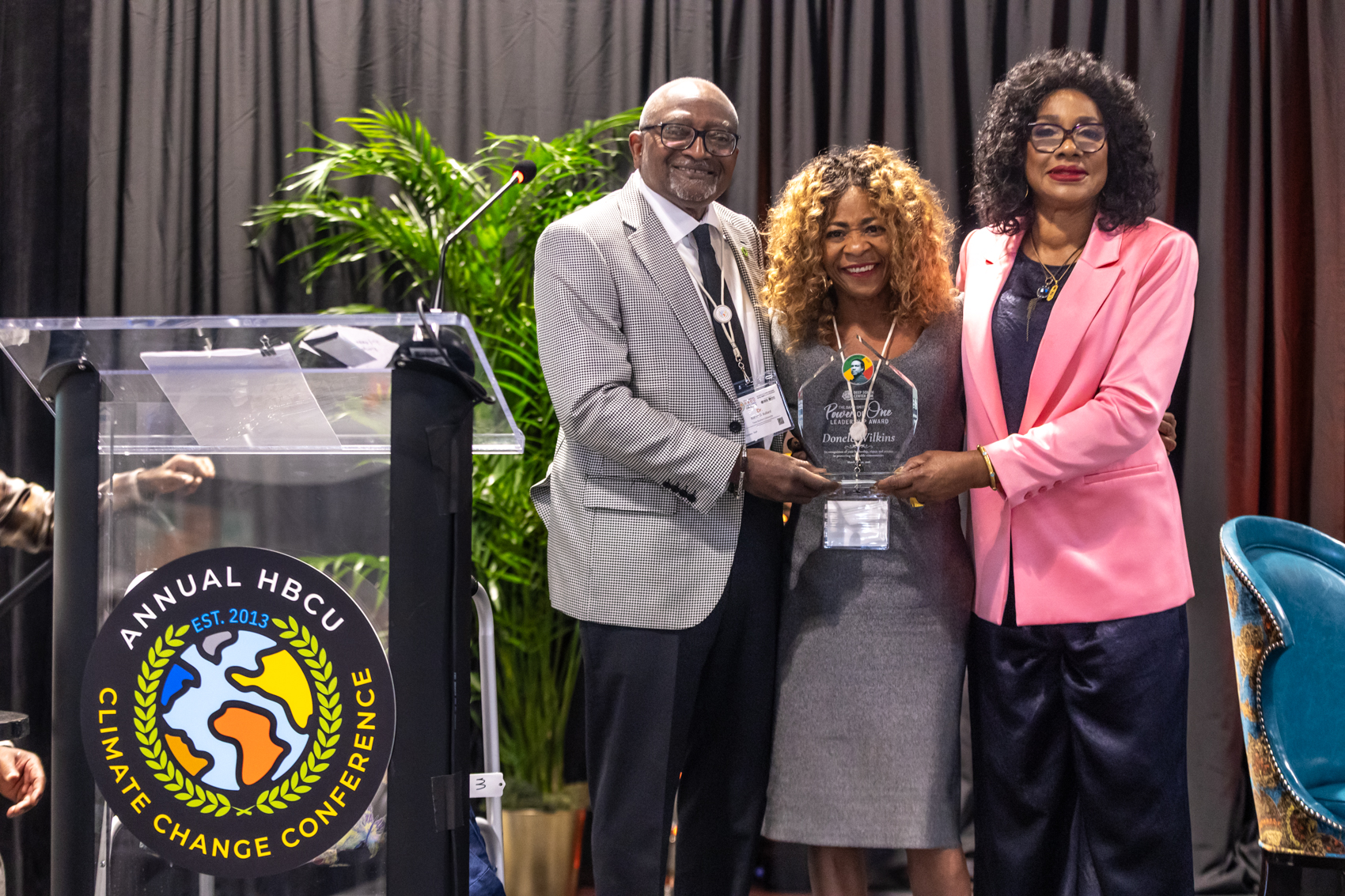
High energy filled the room as the Damu Smith Power of One Award was bestowed upon Ms. Donele Wilkins, founder and CEO of Green Door Initiative. Rev. Lennox Yearwood, President and CEO of the Hip Hop Caucus, then took the stage as keynote speaker. Yearwood spoke passionately about the intersection of popular culture, research, and storytelling, challenging attendees to reclaim narrative power in the face of systemic harm. When addressing the unique pressures faced by advocates and organizers, Yearwood said, “If you own the story, you own the outcome.”
He then welcomed Mary Aloe, a film producer and writer whose work includes “Breach” starring Bruce Willis and “Bruised” starring Halle Berry, to expand on the role of storytelling in social change. Drawing from personal experience, she shared how translating research into compelling narratives can elevate community voices and bring visibility to the real impacts of environmental injustice.
Representing the Bullard Center for Environmental and Climate Justice, Dr. Denae King moderated a panel examining findings from the Center’s in-house report, “Green Light to Pollute in Texas.” Dr. Robert Bullard and Dr. Liza Powers detailed how Texas has become the epicenter of petrochemical expansion, leading the nation in proposed facilities. The report examined the scope of this growth and its consequences for fenceline communities, revealing that 42 percent of the nation’s petrochemical capacity flows through Houston and surrounding areas, a concentration with serious implications for public health and environmental equity.
The Bullard Center then passed the baton to our student representatives, starting with Joseph Carter, a Texas Southern University political science major. Carter framed his research on mold exposure as a courtroom case against the state of Michigan. He shared how prolonged mold exposure played a central role in the deterioration of his own health. His presentation underscored the personal stakes behind policy decisions and environmental neglect. The Bullard Center’s Environmental Justice Climate Corps made a strong showing, with Caszhmere Chaison and Kynsington Hobbs representing their 2025 cohort on a student panel. Their presentations explored critical issues shaping the next generation, including air quality concerns and disaster preparedness communication. This trio underscored the importance of investing in young leaders as architects of future solutions.
The room then fell silent as attendees watched trailers documenting the lived experiences of Hurricane Katrina survivors. Filmmaker Edward Buckles, Jr. shared that he was compelled to tell the story from a perspective often overlooked….the children of Katrina.
“I finished this film at 28, and we were editing until I turned 30. It was difficult to revisit those moments, but it was important to tell a story that I knew was real and true before the world took it away from me,” Buckles shared.
Traci A. Curry, who led efforts to document the 20th anniversary of Katrina, emphasized the role of disappearing natural barriers in amplifying the storm’s devastation. She credited Dr. Beverly Wright’s research as essential to reframing Katrina as an environmental justice crisis rather than a singular natural disaster. Curry said, “One of my favorite quotes is ‘If you’re silent about your pain, they’ll kill you and say you liked it.’ So, it’s important for us to be loud and insistent about what we’ve been through.”
Day Three:
A central theme across the conference was the urgent need to fully endow the HBCU Climate Change Consortium. Dr. Robert Bullard made a compelling case, drawing from decades of movement-building and scholarship. Dr. Bullard reflected on his entry into EJ through the landmark fight against the Whispering Pines Waste Facility, which was proposed for a Black neighborhood in Houston. It was an early example of environmental racism that helped shape the national movement.
Conference leaders emphasized that the movement cannot depend on political cycles. “The movement was not born inside government, and it cannot be stopped by government,” Dr. Bullard stressed. Despite limited funding, enormous progress has been made. But Dr. Bullard emphasized that even more could be achieved with sustained resources. All five original environmental justice centers were founded at HBCUs—Xavier University, Clark Atlanta University, Florida A&M University, Hampton University, and Texas Southern University, demonstrating the unique role these institutions play. When paired with community-based organizations, this model produces lasting change. Dr. Beverly Wright has coined the term the “Communiversity Model.”
When asked by Joseph Carter what young people can do to continue the fight, Dr. Bullard’s response was simple but powerful: MORE. More commitment, more resilience, and more people brought into the work. He said, “The first word of the day is endowment; last word of the day is endowment!”
Day three of the conference highlighted the movement’s international experts, represented by Dr. Gregory Jenkins, a professor at Penn State University, Mithika Mwenda and Zamzam Boru. Dr. Jenkins shared how climate change lives in the memories of the elders and the future of the children. He also outlined the scientific findings that show how the global north is where most of the climate emissions are coming from, however the global south is where we see the greatest impact. Audience members commented on how it was important to connect the Africa to other allies within the diaspora as we forge forward with this movement.
Keynote speaker Dr. Calvin Mackie energized the room with a personal story about his son’s waning interest in science, which inspired the creation of STEM NOLA. “You can take our funding, you can write us off, but we will keep doing the work,” said Mackie, while urging young people to step forward even when fear is present. His message was clear: do the work—regardless of obstacles.
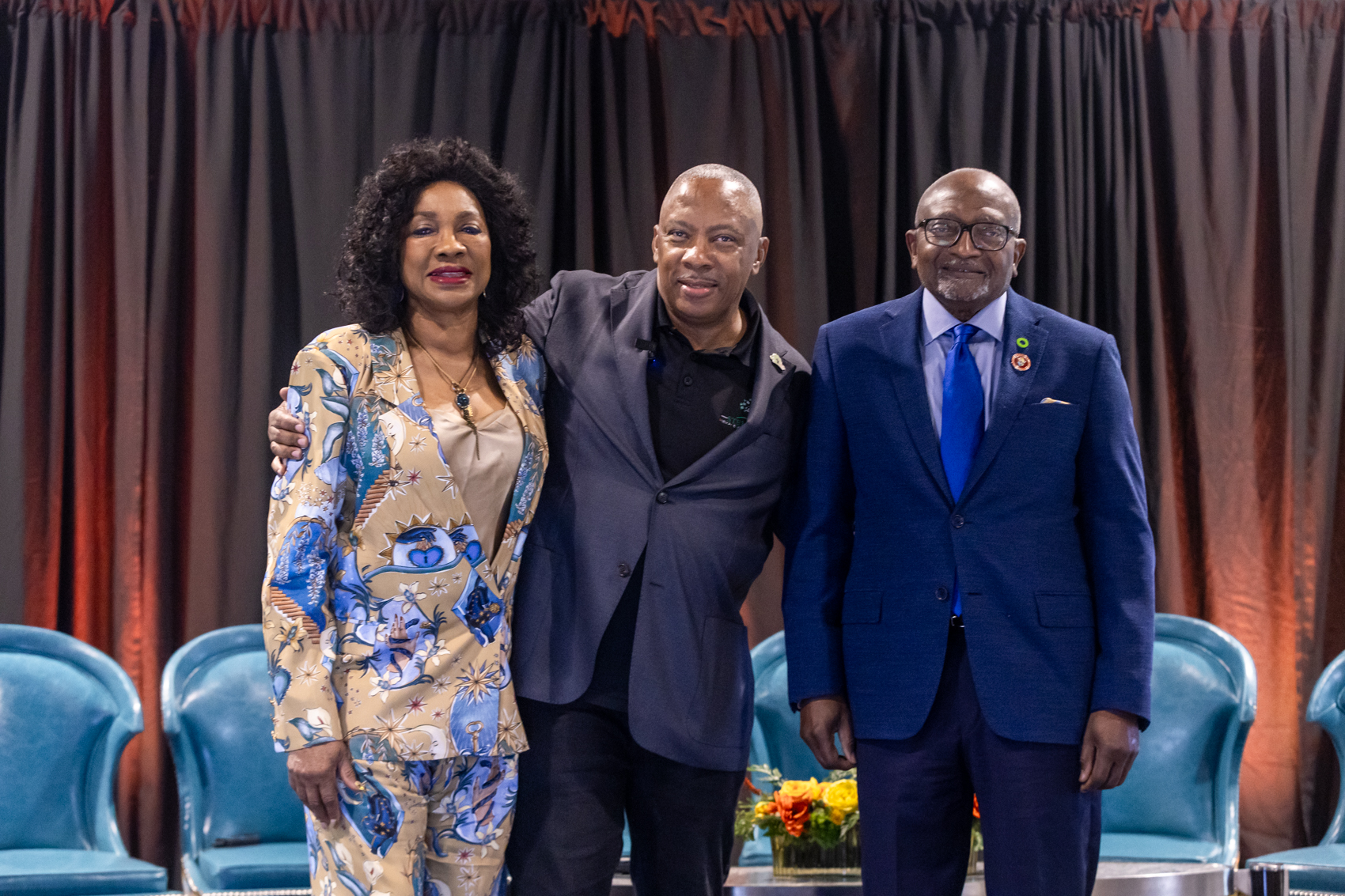
Representatives from Earthjustice, Lawyers for Good Government, and the Southern Environmental Law Center were on hand to outline current legal challenges, including federal efforts targeting over $80 billion in EJ, climate and DEI funding, regulatory rollbacks, and shifts within the EPA that favor polluting industries. Proposed solutions included litigation, technical assistance, citizen enforcement, and localized advocacy. Ben Grillot of the Southern Environmental Law Center offered a forward-looking reminder: “This administration won’t last forever. This climate won’t last forever. Let’s imagine what we want the world to look like on the other side.”
Community voices were featured with Pastor Timothy Williams, Executive Director of the Shiloh Community Center, who shared his decade-long fight for water equity in Alabama after a highway expansion caused repeated flooding in his historic community.
Two Texas Southern University students closed out the day with presentations on environmental education and resilience and data centers. Chloe Webber explored how environmental exposure, infrastructure gaps, and climate stressors intersect in vulnerable communities, proposing resilience strategies centered on knowledge and preparedness. Michaela Dixon-Peltier addressed the rapid expansion of data centers, noting that 85 percent are clustered in or near minority communities, raising concerns about water use, energy demand, and pollution. Her final question lingered with the audience: who pays the price for “progress”?
Day Four:
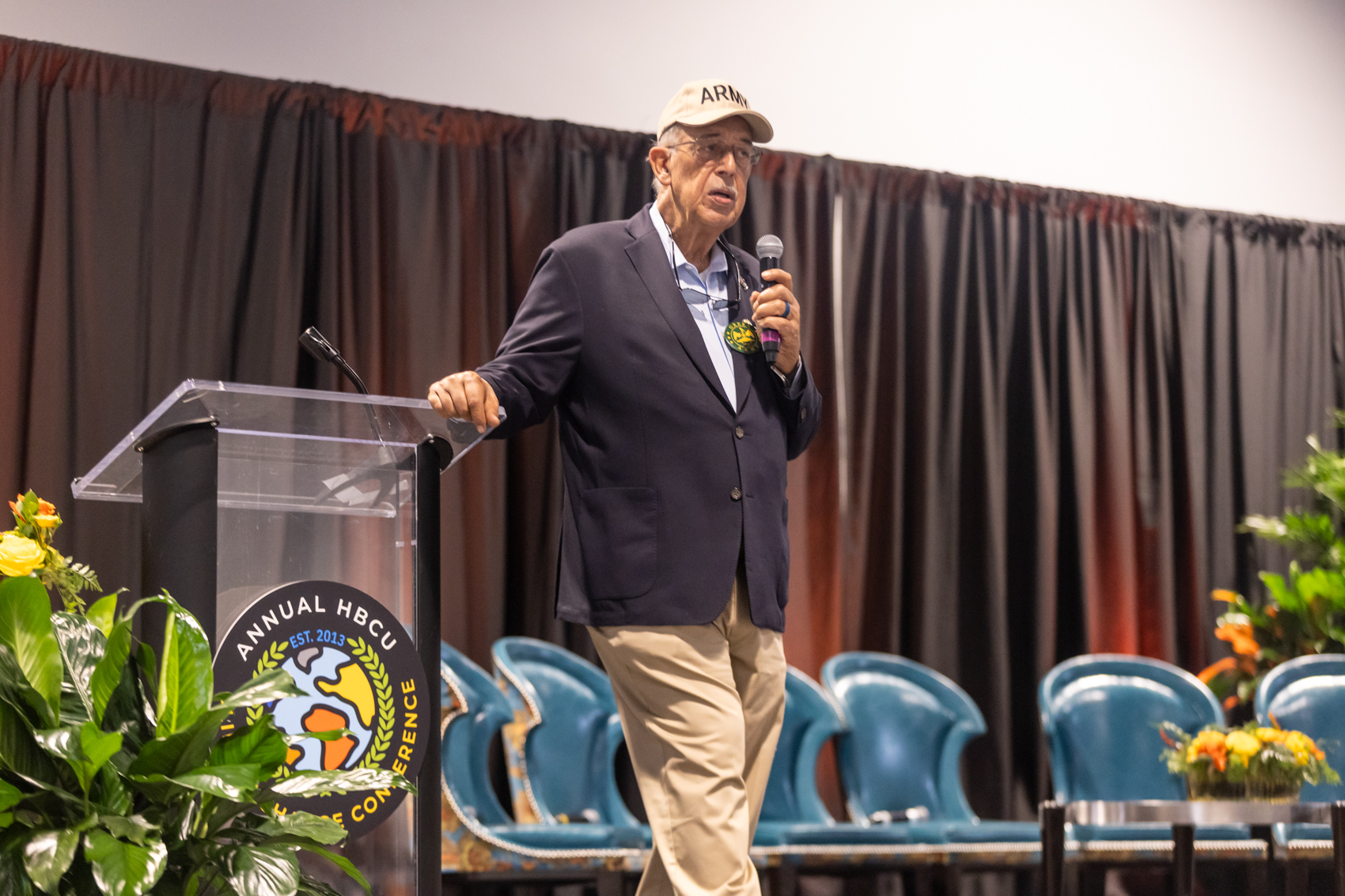
General Russel Honore’ closed out the keynote speaker series. He set aside prepared remarks to deliver an urgent, unscripted call to action for the next generation of environmental justice leaders. Framing climate change as the defining fight of this generation, Honoré made it clear that there is no room for spectators in this moment, only participants. He challenged attendees, particularly young people, to step into leadership, emphasizing that protecting democracy and safeguarding the planet are inseparable struggles. Citing the disproportionate vulnerability of Black communities, more than half of whom live in the South in areas prone to flooding and extreme weather, Honoré called for a fundamental shift in mindset around waste, consumption, and civic engagement. He urged students to vote, to be persistent, and to refuse complacency. Through his work leading the Green Army, Honoré underscored that solutions to pollution and climate harm are possible, but only if this generation is willing to “blow the whistle,” by making some noise while fully committing to the fight ahead.
Closing out a phenomenal showing at the 2026 conference, Texas Southern University students took home both 1st and 2nd place in the undergraduate abstract poster competition. Caszhmere Chaison, Camryn Cummings and Evan Henderson were awarded top honors for their research on monitoring air quality across Houston’s Sunnyside neighborhood. Their findings showed that the air quality often reached extremely unhealthy levels, sometimes three times higher than what’s considered safe for breathing. The strong connection between poor air quality and high rates of asthma and chronic lung illness emphasizes the importance of policy changes, improved green infrastructure, and stronger regulation of neighboring industrial and transportation emissions. Joseph Carter’s research on uncovering the neuroimmune impacts of mold in under-resourced communities secured second place.
Over four days, scholars, students, organizers, artists, and advocates demonstrated that environmental and climate justice are not only rooted in history, but actively being reshaped by those bold enough to carry it forward. From ancestral memory and rigorous research to youth leadership and urgent calls to action, the conference reaffirmed that HBCUs remain essential incubators for partnerships and solutions grounded in community, accountability, and resilience.